
Constructive Connector Characteristics for Folding and Sliding Doors
Access
Ribbon : [Master Data] > Element Manager > Connections > Connectors
General
The constructive connector characteristics describe specific properties of connectors. For example, they influence the position of the connector within the article.
Shortcut definitions:
S = available for sliding doors
F = available for folding doors
SF = available for folding/sliding doors
TT = Part Types
Application Possibility
This table provides an overview of all constructive connector characteristics for sliding doors, folding doors, and folding sliding doors.
The left column contains the chracateristic's name from the user interface. The name in parentheses is the name in the database.
In addition to the category and the allowed value types, the last three columns list the part types (folding/sliding doors) (TT) for the various construction designs where this characteristic can be applied.
Feature Name (DB Name)  |
Category |
Possible Values | S - TT | F - TT | SF - TT |
|---|---|---|---|---|---|
| Gap Left Guide (SFFUEHR_ABST_LI) | Connector | Number | 1,8,9,24 | 1,2,8,9 | 1,2,8,9 |
| Gap Right Guide (SFFUEHR_ABST_RE) | Connector | Number | 1,8,9,24 | 1,2,8,9 | 1,2,8,9 |
| Gap Door Bottom Edge to Base Bottom Edge (SF_BASE_HEIGHT) | Cabinet Construction | Number | 1,2,3 | 1,2,3 | 1,2,3 |
| Processing Number (SFFUEHR_BEARBNR) | Connector | Number | 1,8,9 | 1,2,8,9(,5,6,7) | 1,2,8,9 (,5,6,7) |
| Order Quantity (BEST_ANZ) | Bill of Materials/Reports | Number | * | * | * |
| Shelf Support (BODENAUFL) | Cabinet Construction | Yes, No | 1/3 | 1/2/3 | 1/2/3 |
| Shelf Recess (BODEN_EINR) | Cabinet Construction | Yes, No | 1/3 | 1/2/3 | 1/2/3 |
| Buffer Height Reference (SF_BUFFER_HREF) | Connector | 0 = top only 1 = bottom only 2 = top and bottom | 9 | 9 | 9 |
| Thickness of Upper Shelf Reinforcement (OB_VERST_ST) | Cabinet Construction | Number | 1/3 top | 1/2/3 top | 1/2/3 top |
| Double Rail (SFSCHIEN_DOPPEL) | Rail | Yes, No | 3 | ||
| Double-Sided Rail (SF_DOUBLE_SIDED_SLIDE) | Rail | Yes, No | 3 | 3 | 3 |
| Top/Bottom Installation (PREFERRED_SIDE) | Connector and Rail | Top Installation, Bottom Installation | 1,3,24 | 1,2,3,24 | 1,2,3,24 |
| Recess Division (INNENAUF_EINR) | Cabinet Construction | Number | 1/3 | 1/2/3 | 1/2/3 |
| Top Shelf Recess (TOPSHELFINSET) | Cabinet Construction | Number | 1/3 top | 1/2/3 top | 1/2/3 top |
| Top Shelf Reinforcement Recess (OB_VERST_EINR_VO) | Cabinet Construction | Number | 1/3 top | 1/2/3 top | 1/2/3 top |
| Bounding Box Endpoint X (ENDPOINT_BOUNDING_BOX_X) | General | Number | |||
| Bounding Box Endpoint Y (ENDPOINT_BOUNDING_BOX_Y) | General | Number | |||
| Bounding Box Endpoint Z (ENDPOINT_BOUNDING_BOX_Z) | General | Number | |||
| Always Use Connector Gap (SF_GAP_ALWAYS_FROM_CONNECTOR) | Cabinet Construction | Any Value | 1/3 | 1/2/3 | 1/2/3 |
| Geometry DWG (SFSCHIEN_DWG) | Rail | Filename | 3 | 3 | 3 |
| Height Reference Guide (SFFUEHR_REF_HOEHE) | Connector | 1 = Inside bottom 2 = Outside bottom | 1 | 1/2 | 1/2 |
| ID of Mirrored Connector (KOMPLEMENT_ID) | Connector | Item ID of an accessory connector | |||
| Hide in Connector Scan (SHOW_DIALOG_FALSE) | General | Yes No | * | * | * |
| Collision Grid (COLLISION_GRID) | General | ||||
| Constant 1 (CONSTANT_1) | General | Number | |||
| Constant 2 (CONSTANT_2) | General | Number | |||
| Constant 3 (CONSTANT_3) | General | Number | |||
| Constant 4 (CONSTANT_4) | General | Number | |||
| Construction Type (KONSTTYP) | Cabinet Construction | Inset, Overlay, Behind Front Panel | 1/3 | 1/2/3 | 1/2/3 |
| Cabinet Recess (KORPUSEINR) | Cabinet Construction | Number | 1/3 | 1/2/3 | 1/2/3 |
| Linear Division for Gaps in the Rail (SF_GAP_LINDIV) | Rail | Linear Division Descriptor | 1/3 | 1/2/3 | 1/2/3 |
| Linear Division for Side Gap (SFFUEHR_ABST_LINDIV) | Connector | Linear Division Descriptor | 1,8,9,24 | 24 | 24 |
| Minimum Bottom Thickness (MIN_BD_THK) | Cabinet Construction | Number | 1/3 | 1/2/3 | 1/2/3 |
| Rail Groove Width (SFSCHIEN_NUTBREITE) | Rail | Number | 3 | 3 | 3 |
| Rail Groove Depth (SFSCHIEN_NUTTIEFE) | Rail | Number | 3 | 3 | 3 |
| Groove Inheritance (GROOVE_CONSTRUCTION) | Rail | Groove Inheritance Principle | 3 | 3 | 3 |
| Grid Measure (COLLISION_OFFSETS) | General | ||||
| Reference for Rail Length (SF_SLIDE_SREF) | Rail | 0 = Cabinet Internal Dimension 1 = Door Center | 1/3 | 1/2/3 | 1/2/3 |
| Sliding and Folding Door Type / Part Type (SFTYP) | All | see Part Types Folding/Sliding Doors | |||
| Attach Rail to Door (SFSCHIEN_TUER) | Rail | 0 = No 1 = Yes | 3 | 3 | 3 |
| Insert Rail (SFFUEHR_SCHIENE) | Rail | 0 = No 1 = Yes | 1 | 1/2 | 1/2 |
| Rail Offset (SFFUEHR_SCHIENE_DT) | Rail | Number | 1 | 1/2 | 1/2 |
| Side Recess (SEITE_EINR) | Cabinet Construction | Yes, No | 1/3 | 1/2/3 | 1/2/3 |
| Side Reference Guide (SFFUEHR_REF_SEITE) | Connector | 0=Door Outer Edge 1=Cabinet Inside Edge 2=Cabinet Center 3=Cabinet Outer Edge 4=Maximum of Cabinet Inside Edge and Door Outer Edge | 1 | 1 | 1 |
| Set Article (IS_SET) | Parts List/Reports | Yes, No | * | * | * |
| Base Recess (SOCKEL_EINR) | Cabinet Construction | Yes, No | 1/3 | 1/2/3 | 1/2/3 |
| Starting Point Bounding Box X (STARTPOINT_BOUNDING_BOX_X) | General | Number | |||
| Starting Point Bounding Box Y (STARTPOINT_BOUNDING_BOX_Y) | General | Number | |||
| Starting Point Bounding Box Z (STARTPOINT_BOUNDING_BOX_Z) | General | Number | |||
| List Parts Individually in Order List (SF_DONT_TREAT_AS_SET) | Parts List/Reports | Yes | * | * | * |
| Middle Hinge Division (MSCHARN_LIN) | Connector | Linear Division, Descriptor | 5 | 5 | |
| Depth of Top Shelf Reinforcement (OB_VERST_TIEFE) | Cabinet Construction | Number | 1/3 Top | 1/2/3 Top | 1/2/3 Top |
| Depth Reference Guide (SFFUEHR_REF_TIEFE) | Connector | 1=Door Backside 2=Door Center 3=Door Frontside 4=Base Frontside 5=Front Edge of Shelf | 1/8/9 | 1/2/8/9 | 1/2/8/9 |
| Depth Offset Groove (SFSCHIEN_NUTVERSATZ) | Rail | Number | 3 | 3 | 3 |
| Door Clearance (ABST_TUER) | Cabinet Construction | Number | 1/3 | ||
| Door Clearance Depth Reference (REF_ABST_TUER) | Cabinet Construction | 1=Between Door Front Edges 2=Clear Width Between the Doors | 1/3 | ||
| Door Gap Top/Bottom (FUGE_VERTIKAL) | Cabinet Construction | Number | 1/3 | 1/2/3 | 1/2/3 |
| Door Number (SFFUEHR_TUERNR) | Connector | 1,2,3 | 1,8,9 | 1,2,8,9 | 1,2,8,9 |
| Connector Position (SFFUEHR_POSITION) | Connector | Evaluation for sliding doors only: 0=Standard 1=Inside Only 2=Outside Only 3=Left Only 4=Right Only 5=Alternating Right Left 6=Alternating Left Right Evaluation for bi-fold/sliding doors with damper and activator only: 7=Stop Side Only 8=Strike Side Only 9=Stop Side and Strike Side | 1,8,9 | ||
| Side Recess Value (SEITENEINR) | Cabinet Construction | Number | 1/3 | 1/2/3 | 1/2/3 |
| Base Recess Value (SOCKELEINR) | Cabinet Construction | Number | 1/3 | 1/2/3 | 1/2/3 |
Detailed Descriptions
Required Features in Each Connector of the Connector Set
Features Affecting Cabinet Construction
Required Characteristics in Each Connector of the Connector Set
Sliding and Folding Door Type / Part Type (SFTYP)
Description
A complex fitting consists of several components. This feature defines the type of part a connector is.
This value must be specified for all connectors to ensure a referenced installation. If no value is entered, the element is recorded as an accessory, which is always inserted at the zero point of the item.
Possible values
0 = Accessory (feature not assigned)
1 = Outer Guide / Slider
2 = Middle Guide
3 = Rail
4 = Outer Hinge
5 = Middle Hinge
6 = Closing Plate
7 = Guide Angle
8 = Activator for Damper
9 = Damper
10 = Slats
11 = Handle Strip
12 = 90° Corners
13 = Screws
14 = Winding Mechanisms
15 = Winding Mechanism Rods
16 = Lisens
17 = Cover
18 = End Caps
19 = Middle Stopper
20 = Brakes
21 = Cable Systems
22 = Winding Mechanism Rod Extensions
23 = Caddy Brake
24 = Rail Connector
Interaction with Other Characteristics
-
Notable
Not all part types are applicable to all versions of the folding and sliding mode. A detailed overview of the part types and their installation conditions can be found here.
Installation Top/Bottom (PREFERRED_SIDE)
Description
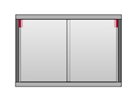
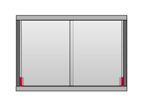
With the help of this characteristic, it is defined whether a connector is installed at the top or bottom in the article zone.
Possible Values
Installation Top
Installation Bottom
Interaction with Other Characteristics
-
Notable
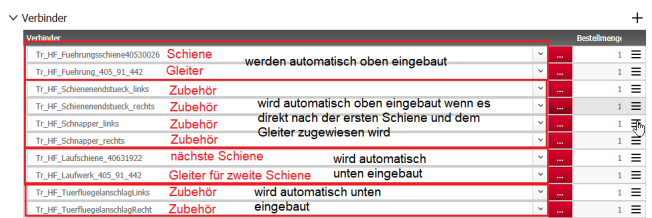
If this value is not assigned, imos will arrange the elements according to the sorting in the connector set. To ensure correct positioning, this characteristic should always be assigned.
Entry for Part Type
Sliding Door: 1,3,24
Folding and Bi-Fold Sliding Door: 1,2,3,24
Characteristics Affecting Rails
Geometry DWG (SFSCHIEN_DWG)
Description

The filename of a DWG that contains the cross-section of the rail.
The DWG must contain only a single closed polyline. The drawing must be created to represent the cross-sectional geometry of the rail as viewed from the right.
The file must be located in the directory …\Library\ConnDWG.
Possible values
File name
Interaction with Other Characteristics
-
Notable
-
Entry for Part Type
Sliding Door: Always at 3
Folding and Bi-Fold Sliding Door: Always at 3
Reference for Rail Length (SF_SLIDE_SREF)
Description
The rail is either the length of the clear internal dimension or extends from the center of the first door to the center of the last door.
Possible Values
0 = Cabinet Internal Dimension
1 = Door Centers
Interaction with Other Characteristics
-
Notable
-
Entry for Part Type
Sliding Door: 1 or 3
Folding and Bi-Fold Sliding Door: 1 or 2 or 3
Linear Division for Gaps in the Rail (SF_GAP_LINDIV)
Description
Using linear division, a gap in the running rail can be defined. The division alternates between gap and rail sections.
Possible Values
Linear division or descriptor.
Interaction with Other Characteristics
-
Notable
-
Entry for Part Type
Sliding Door: 3
Folding and Bi-Fold Sliding Door: 3
Install Rail (SFFUEHR_SCHIENE)
Description
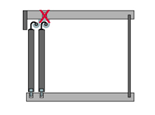
This characteristic defines whether a rail is installed at the assigned door number or not.
1 = Yes = A rail is inserted.
0 = No = No rail is inserted. This can be the case when a double rail is used, and two rows of doors share one rail.
A separate characteristic value can be entered for each row of doors. The individual values are separated by a vertical bar “|” (e.g., 1|0). The characteristic “door number” defines how the characteristics are assigned.
Possible Values
0 = No
1 = Yes
Interaction with Other Characteristics
-
Notable
Sliding Doors:
A rail is only installed if a part of the type “Outer Guide / Slider” is created in the connector set and the characteristic is set to “Yes.”
This characteristic should only be used once. If it is assigned to multiple connectors, this can result in several rails being inserted at the same position unnoticed, thus distorting the parts list!
Entry for Part Type
Sliding Door: 1
Folding and Bi-Fold Sliding Door: 1 or 2
Groove Inheritance (GROOVE_CONSTRUCTION)
Description
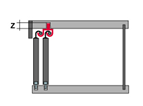
By default, the STANDARD groove inheritance principle is used. If another groove inheritance principle is to be used, it must be created and entered here.
Possible Values
Name of the groove principle.
Interaction with Other Characteristics
-
Notable
-
Entry for Part Type
Sliding Door: 3
Folding and Bi-Fold Sliding Door: 3
Groove Width Rail (SFSCHIEN_NUTBREITE)
Description
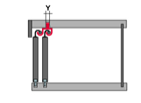
If the rail is to be grooved, this value corresponds to the width of the groove. If this value is "0", no groove will be created. Other parameters, such as linear division, come from the groove inheritance principle.
Possible Values
Number (freely editable)
Interaction with Other Characteristics
-
Notable
-
Entry for Part Type
Sliding Door: 3
Folding and Bi-Fold Sliding Door: 3
Groove Depth Rail (SFSCHIEN_NUTTIEFE)
Description
If the rail is to be grooved, this value corresponds to the depth of the groove. If this value is "0", no groove will be created. Other parameters, such as linear division, come from the groove inheritance principle.
Possible Values
Number (freely editable)
Interaction with Other Characteristics
-
Notable
-
Entry for Part Type
Sliding Door: 3
Folding and Bi-Fold Sliding Door: 3
Groove Depth Offset (SFSCHIEN_NUTVERSATZ)
Description
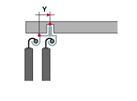
This characteristic shifts the groove relative to the insertion point of the rail.
A depth offset value of "0" sets the groove centered to the insertion point of the rail.
A positive value shifts the groove into the corpus; a negative value shifts the groove outward.
Possible Values
Number (freely editable)
Interaction with Other Characteristics
-
Notable
-
Entry for Part Type
Sliding Door: 3
Folding and Bi-Fold Sliding Door: 3
Attach Rail to Door (SFSCHIEN_TUER)
Description
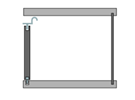
If this characteristic is set, the rail will be attached to the door.
Possible Values
0=No
1=Yes
Interaction with Other Characteristics
-
Notable
-
Entry for Part Type
Sliding Door: 3
Folding and Bi-Fold Sliding Door: 3
Rail Offset (SFFUEHR_SCHIENE_DT)
Description
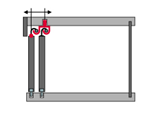
Shift the rail relative to the insertion point of the guide. Positive values shift the rail inward; negative values shift it outward.
Each door row can have its own characteristic value. The individual values are separated by a vertical bar "|" (e.g., 10|20). The "Door Number" characteristic defines how the characteristics are assigned.
Possible Values
Number (freely editable)
Interaction with Other Characteristics
-
Notable
-
Entry for Part Type
Sliding Door: 1
Folding and Bi-Fold Sliding Door: 1 or 2
Double Rail (SFSCHIEN_DOPPEL)
Description
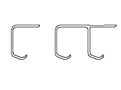
Defines the type of rail.
Yes = Two doors can be mounted on the rail.
No = Only one door can be mounted on the rail.
This characteristic is obsolete. The number of door rows on a rail is controlled by the "Install Rail" characteristic (SFFUEHR_SCHIENE).
Possible Values
0=No
1=Yes
Interaction with Other Characteristics
-
Notable
-
Entry for Part Type
Sliding Door: 3
Double-Sided Rail (SF_DOUBLE_SIDED_SLIDE)
Description
Used when sliding doors from overlapping article zones share a rail.
Possible Values
0=No
1=Yes
Interaction with Other Characteristics
-
Notable
Application: There is a sliding door fitting in overlapping article zones. All zones should receive the same KP and connector set. Using this characteristic, only the top zone receives two rails, while the lower zones each receive only one lower rail.
! The profile connector (rail) must be listed twice in the connector set.
! "Installation top/bottom" should not be used for the rails.
Entry for Part Type
Sliding Door: 3
Folding and Folding Sliding Door: 3
Characteristics Affecting Connectors
Operation Number (SFFUEHR_BEARBNR)
Description
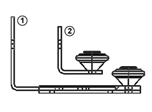
For a connector composed of multiple individual parts, a processing group number is defined for each part, which is used for the reference of the component. The processing number entered in the characteristic refers to the used processing group number. There must be a number 1; a processing group number can be used multiple times if necessary.
Each door row can have its own characteristic value. The individual values are separated by a vertical bar "|" (e.g., 1|2). The characteristic "door number" defines how the characteristics are assigned.
Possible values
Number (freely editable)
Wechselwirkung mit anderen Merkmalen
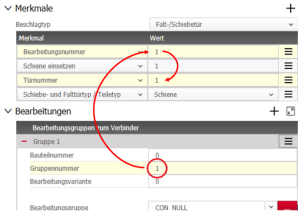
Works together with the characteristic "door number."
The door number refers to the characteristic "processing number."
The processing number refers to the processing group number.
Notable
Folding and bi-folding doors: Part types 5, 6, and 7 are only referenced by processing group number; no door number needs to be assigned.
Entry for Part Type
Sliding Door: 1, 8, 9
Folding and Bi-folding Door: 1, 2, 8, 9
Door Number (SFFUEHR_TUERNR)
Description
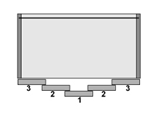
This characteristic defines which door row or segments the entered characteristic values are applied to.
Possible Values
1, 2, 3
Interaction with Other Characteristics
Works together with the characteristic "Processing Number".
The door number refers to the characteristic "Processing Number".
The processing number refers to the processing group number.
Notable
Sliding Doors:
Door number 1 = Front door row
Door number 2 = Middle door row
Door number 3 = Rear door row
Only 2 door rows are controllable through the user interface. (1=outer/2=inner)
Folding Doors:
Door number 3 = Left hinged door packages
Door number 1 = Right hinged door packages
Bi-folding Doors:
Door number 1 = Left door leaf; left outer
Door number 2 = Middle door leaf; center
Door number 3 = Right door leaf; right outer
Entry for Part Type
Sliding Door: 1, 8, 9
Folding and Bi-folding Door: 1, 2, 8, 9
Distance Guide Left (SFFUEHR_ABST_LI)
Description
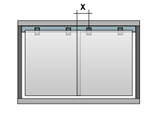
Distance of the connectors from the outer sides of the door.
A separate characteristic value can be entered for each door row. The individual values are separated by a hyphen. The characteristic "Door Number" defines how the characteristics are assigned.
Possible Values
Number (freely editable)
Interaction with Other Characteristics
Overridden if "Linear Division for Lateral Distance" is used.
Notable
-
Entry for Part Type
Sliding Door: 1, 8, 9, 24
Folding and Bi-folding Door: 1, 2, 8, 9
Distance Guide Right (SFFUEHR_ABST_RE)
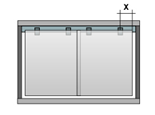
See Distance Guide Left
Linear Division for Lateral Spacing (SFFUEHR_ABST_LINDIV)
Description
This characteristic aligns connectors laterally.
Possible Values
Linear division or descriptor.
Interaction with Other Characteristics
It replaces the characteristics “Distance Guide Right SF_ABST_RE” and “Distance Guide Left SF_ABST_LI”.
Notable
The number of connectors resulting from the division is not recorded as usual in the parts list.
Entry by Part Type
Sliding door: 1,8,9,24
Folding and sliding folding door: 24
Connector Position (SFFUEHR_POSITION)
Description
This parameter allows you to specify where the connectors are laterally attached to the door leaf. The value 0=Standard means connectors on the left and right of the door leaf.
A separate characteristic value can be entered for each door row. The individual values are separated by a vertical bar “|” (e.g., 1|0).
Possible Values
The values 0 to 6 of the characteristic are only evaluated for sliding doors, as they are only meaningful there.
0=Standard
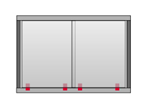
1=Inside only
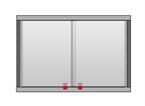
2=Outside only
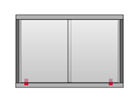
3=Left only
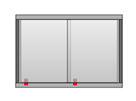
4=Right only
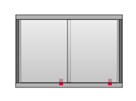
5=Alternating right left
6=Alternating left right
The values 7 to 9 of the characteristic are only evaluated for folding and sliding folding doors, and only for buffers and activators for buffers.
7=Strike side only
8=Latch side only
9=Strike and latch sides
Interaction with Other Characteristics
The characteristic “Linear division for lateral spacing” nullifies this characteristic.
Notable
-
Entry by Part Type
Sliding door: 1,8,9
Height Reference Guide (SFFUEHR_REF_HOEHE)
Description
The characteristic defines the insertion point of the connectors.
1 = The insertion point of the guide is on the inner side of the shelf.
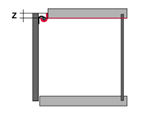
2 = The insertion point of the guide is on the outer side of the shelf.
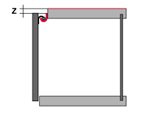
Changing the value rotates the connector around its Y-axis. The orientation is always such that the Z-axis points towards the center of the shelf.
A separate characteristic value can be entered for each door row. The individual values are separated by a vertical bar “|” (e.g., 1|2). The characteristic “Door Number” defines how the characteristics are assigned.
Possible Values
1,2
Interaction with Other Characteristics
Also determines the insertion point in Z for tracks and track connectors.
Notable
-
Entry by Part Type
Sliding door: 1,8,9
Folding and sliding folding door: 1,2,8,9
Lateral Reference Guide (SFFUEHR_REF_SEITE)
Description
The characteristic defines how the outer guide should be aligned laterally.
A separate characteristic value can be entered for each door row. The individual values are separated by a vertical bar “|” (e.g., 1|2). The characteristic “Door Number” defines how the characteristics are assigned.
Possible Values
0=Door outer edge
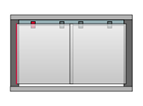
1=Cabinet inner side
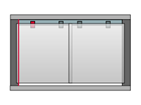
2=Cabinet center
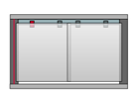
3=Cabinet outer side
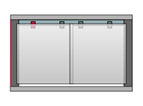
4=Maximum of cabinet inner side and door outer edge
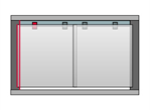
Interaction with Other Characteristics
-
Notable
Has no effect on sliders positioned in the center of the cabinet.
Entry by Part Type
Sliding door: 1
Folding and sliding folding door: 1
Depth Reference Guide (SFFUEHR_REF_TIEFE)
Description
The characteristic defines the reference point for the depth of the connectors.
A separate characteristic value can be entered for each door row. The individual values are separated by a vertical bar “|” (e.g., 1|2). The characteristic “Door Number” defines how the characteristics are assigned.
Possible Values
1=Back of the door
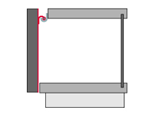
2=Middle of the door
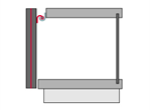
3=Front of the door
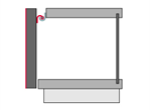
4=Front of the base
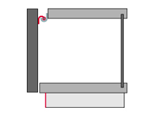
5=Front edge of the shelf
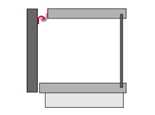
Interaction with Other Characteristics
-
Notable
-
Entry by Part Type
Sliding door: 1,8,9
Folding and sliding folding door: 1,2,8,9
Damper Height Reference (SF_BUFFER_HREF)
Description
Specifies how dampers are positioned in cabinet height.
Possible Values
0 = top only
1 = bottom only
2 = top and bottom
Interaction with Other Characteristics
Applies simultaneously to "Damper" and "Activator for Damper", but is only entered for dampers.
Notable
-
Entry by Part Type
Sliding door: 9
Folding and sliding folding door: 9
Middle Hinge Division (MSCHARN_LIN)
Description
This characteristic is used to define the number and spacing of middle hinges.
Possible Values
Linear division or descriptor.
Interaction with Other Characteristics
-
Notable
-
Entry by Part Type
Folding and sliding folding door: 5
Characteristics Affecting Cabinet Construction
Shelf Support (BODENAUFL)
Description
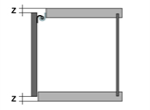
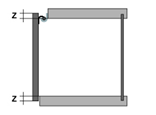
The characteristic defines how the characteristic "Top/Bottom Door Gap" is evaluated for overlay folding-sliding doors.
It can be specified once at the top and once at the bottom in the connector set and then refers to the top edge of the door/top shelf or the bottom edge of the door/bottom shelf.
Yes = Distance between the inside of the shelf and the top or bottom edge of the door.
No = The characteristic is read "normally": Gap corresponds to the value from the front unfolding or the construction principle (each to the outer side of the shelf).
Possible Values
0=No
1=Yes
Interaction with Other Characteristics
-
Notable
-
Entry for Part Type
Sliding Door: 1 or 3
Folding and Folding Sliding Door: 1 or 2 or 3
Top/Bottom Door Gap (FUGE_VERTIKAL)
Description
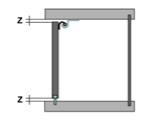
For flush doors or behind fillers:
Defines the gap at the top or bottom between the door and the inside of the shelf.
For overlay doors:
Defines the distance between the outside of the shelf and the top or bottom edge of the door.
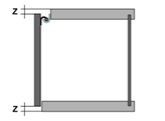
The value can be specified once for the top and once for the bottom per connector set. If the value is specified multiple times, the higher value is used. The gap value from the construction principle or the visual data principle is overridden.
Possible Values
Number (freely editable)
Interaction with Other Characteristics
-
Notable
-
Entry for Part Type
Sliding Door: 1 or 3
Folding and Folding Sliding Door: 1 or 2 or 3
Always Use Gap from Connector (SF_GAP_ALWAYS_FROM_CONNECTOR)
Description
Door gaps can be defined in the construction principle or in the connector. If this characteristic is not used, the higher value is used.
If the characteristic is used, the value from the connector is always used.
Possible Values
1=Yes
Interaction with Other Characteristics
-
Notable
-
Entry for Part Type
Sliding Door: 1 or 3
Folding and Folding Sliding Door: 1 or 2 or 3
Side Recess (SEITE_EINR)
Description
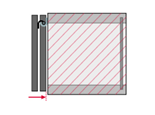
Yes = The cabinet sides are recessed behind the rearmost door. There is as much space between the rearmost door and the cabinet sides as specified by the "Side Recess Value" parameter.
No = The cabinet sides remain as they are. If this value is specified for the rail and the guide, a "Yes" is sufficient to cause the recess.
Possible Values
0=No
1=Yes
Interaction with Other Characteristics
Characteristic "Side Recess Value" specifies the distance value.
Notable
-
Entry for Part Type
Sliding Door: 1 or 3
Folding and Folding Sliding Door: 1 or 2 or 3
Side Recess Value (SEITENEINR)
Description
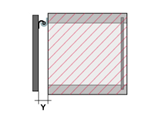
This value specifies the distance between the back of the door and the cabinet sides or the shelf.
The value is only needed for overlay sliding doors. If this value is not specified, the characteristic "Cabinet Recess" is used.
Possible Values
Number (freely editable)
Interaction with Other Characteristics
Default value for the characteristic "Side Recess"
Notable
-
Entry for Part Type
Sliding Door: 1 or 3
Folding and Folding Sliding Door: 1 or 2 or 3
Shelf Recess (BODEN_EINR)
Description
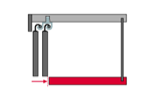
Yes = The shelf is recessed behind the rearmost door. There is as much space between the rearmost door and the shelf as specified by the "Cabinet Recess" parameter.
Can be specified separately for the top and bottom shelf. If the value is specified in multiple connectors at the top or bottom, the largest value is chosen.
Possible Values
0=No
1=Yes
Interaction with Other Characteristics
The height of the distance is specified in the characteristic "Cabinet Recess".
If "Cabinet Recess" is not specified, "Side Recess Value" is used.
Notable
-
Entry for Part Type
Sliding Door: 1 or 3
Folding and Folding Sliding Door: 1 or 2 or 3
Corpus Recess (KORPUSEINR)
Description
Defines the distance between the back of the door and the cabinet sides or the shelf.
If this value is specified for the rail and guide, the higher numerical value is used.
Possible Values
Number (freely editable)
Interaction with Other Characteristics
Is the distance value for the characteristic "Shelf Recess"
Notable
-
Entry for Part Type
Sliding Door: 1 or 3
Folding and Folding Sliding Door: 1 or 2 or 3
Recessed Partition (INNENAUF_EINR)
Description
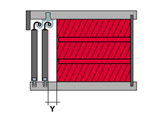
This value indicates how far the internal partition of the article zone (center panels, shelves, and construction shelves) should be recessed behind the rearmost door.
If this value is specified both at the top and bottom, the higher numerical value is used.
Possible Values
Number (freely editable)
Interaction with Other Characteristics
-
Notable
-
Entry for Part Type
Sliding Door: 1 or 3
Folding and Folding Sliding Door: 1 or 2 or 3
Base Recess (SOCKEL_EINR)
Description
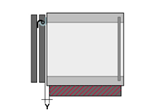
Yes = The base is offset behind the rearmost door by the value of the base recess.
No = The base is not offset.
If this value is specified for both the rail and the guide, a "Yes" is sufficient to cause the recess.
Possible Values
0=No
1=Yes
Interaction with Other Characteristics
The amount of the offset is specified by the "Base Recess Value".
Notable
-
Entry for Part Type
Sliding Door: 1 or 3
Folding and Folding Sliding Door: 1 or 2 or 3
Base Recess Value (SOCKELEINR)
Description
This characteristic specifies the distance between the rearmost door and the base.
If this value is specified for both the rail and the guide, the higher of the two values is used.
Possible Values
Number (freely editable)
Interaction with Other Characteristics
Amount for the base offset. Evaluated only if the characteristic "Base Recess" is set to "yes".
Notable
-
Entry for Part Type
Sliding Door: 1 or 3
Folding and Folding Sliding Door: 1 or 2 or 3
Distance from Bottom of Door to Bottom of Base (SF_BASE_HEIGHT)
Description
Distance between the bottom edge of the door and the bottom edge of the base. Adjusts the base height accordingly.
Possible Values
Number (freely editable)
Interaction with Other Characteristics
-
Notable
-
Entry for Part Type
Sliding Door: 1 or 3
Folding and Folding Sliding Door: 1 or 2 or 3
Thickness of Top Shelf Reinforcement (OB_VERST_ST)
Description
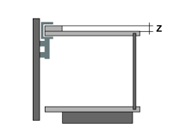
This characteristic defines the thickness of the top shelf reinforcement.
Possible Values
Number (freely editable)
Interaction with Other Characteristics
Installation of a top panel only occurs in combination with "Depth of Top Shelf Reinforcement".
Notable
-
Entry for Part Type
Sliding Door: 1 or 3
Folding and Folding Sliding Door: 1 or 2 or 3
Depth of Top Shelf Reinforcement (OB_VERST_TIEFE)
Description
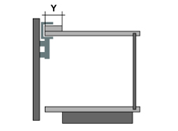
This characteristic defines the depth of the top shelf reinforcement.
Possible Values
Number (freely editable)
Interaction with Other Characteristics
Installation of a top panel only occurs in combination with "Thickness of Top Shelf Reinforcement".
Notable
-
Entry for Part Type
Sliding Door: 1 or 3
Folding and Folding Sliding Door: 1 or 2 or 3
Recess of Top Shelf Reinforcement (OB_VERST_EINR_VO)
Description
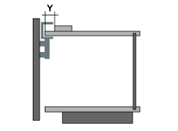
This characteristic specifies the recess of the top shelf reinforcement in the cabinet depth. If the characteristic is used multiple times, the highest value is used.
Possible Values
Number (freely editable)
Interaction with Other Characteristics
-
Notable
-
Entry for Part Type
Sliding Door: 1 or 3
Folding and Folding Sliding Door: 1 or 2 or 3
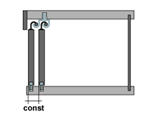
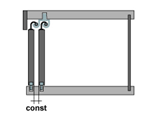
Door Distance Depth Reference (REF_ABST_TUER)
Description
Between front sides of doors:
The distance is defined between the front sides of the doors.
Clear dimension between doors:
The distance is defined between the back of the front door and the front of the rear door.
Possible Values
1=Between front sides of doors
2=Clear dimension between doors
Interaction with Other Characteristics
The amount of the distance is defined in the characteristic "Door Distance Depth Reference".
Notable
-
Entry for Part Type
Sliding Door: 1 or 3
Folding and Folding Sliding Door: 1 or 2 or 3
Door Distance (ABST_TUER)
Description
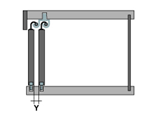
Distance of the door panels in depth.
Possible Values
Number (freely editable)
Interaction with Other Characteristics
Where the distance is measured depends on the door distance depth reference.
Notable
-
Entry for Part Type
Sliding Door: 1 or 3
Folding and Folding Sliding Door: 1 or 2 or 3
Minimum Shelf Thickness (MIN_BD_THK)
Description
Value for the minimum shelf thickness. If the shelf thickness from the component specification is lower, it will be adjusted by the folding sliding door module. Applies only to shelves from the same article zone.
Possible Values
Number (freely editable)
Interaction with Other Characteristics
-
Notable
-
Entry for Part Type
Sliding Door: 1 or 3
Folding and Folding Sliding Door: 1 or 2 or 3
Recess of the Top Shelf (TOPSHELFINSET)
Description
This characteristic sets the Z-value of the top shelf. Recesses the back panel and/or the cabinet sides. A negative value is ignored!
Possible Values
Number (freely editable)
Interaction with Other Characteristics
-
Notable
Sliding Doors: Recess of the back panel and cabinet sides
Folding and Folding Sliding Doors: Recess of the back panel
Entry for Part Type
Sliding Door: 1 or 3 top
Folding and Folding Sliding Door: 1 or 2 or 3 top
Construction Type (KONSTTYP)
Description
This characteristic indicates the type of construction.
A remnant from past versions when sliding doors could not yet be configured in the Article Designer. The control of the construction type is now handled in the construction principle of the article component.
Possible Values
Flush
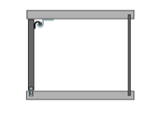
Overlay
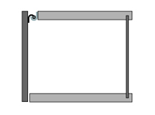
Behind Panel
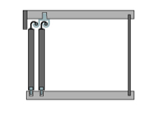
Interaction with Other Characteristics
-
Notable
-
Entry for Part Type
Sliding Door: 1 or 3
Folding and Folding Sliding Door: 1 or 2 or 3
Characteristics Affecting Parts List/Reports
Order Quantity (BEST_ANZ)
Description
Controls the order quantity in the parts list. Works differently in the folding and sliding module compared to other connectors.
Value=0 - Connector does not appear in the parts list
Value ≠ 0 - Quantity in the parts list is controlled by various conditions (e.g., door number and processing group number. Linear divisions are only considered for certain part types)
Possible Values
Number (freely editable)
Interaction with Other Characteristics
-
Notable
-
Entry for Part Type
Usable for all part types.
Set Article (IS_SET)
Description
Provides only one entry in the IDBPURCH table and can be evaluated for individual reports. Has no impact on the construction or the order quantity of the other connectors in the connector set.
Possible Values
0=No
1=Yes
Interaction with Other Characteristics
-
Notable
-
Entry for Part Type
Usable for all part types.
List Parts Individually in Order List (SF_DONT_TREAT_AS_SET)
Description
In most cases, the components of folding and sliding door fittings are traded in sets.
If this characteristic is present in the connector, all components of the connector that appear in the construction are individually included in the parts list.
Possible Values
0=No
1=Yes
Interaction with Other Characteristics
-
Notable
-
Entry for Part Type
Usable for all part types.
ID of Mirrored Connector (KOMPLEMENT_ID)
Description
This characteristic can contain the article number of any connector. The connector does not need to be part of the connector set.
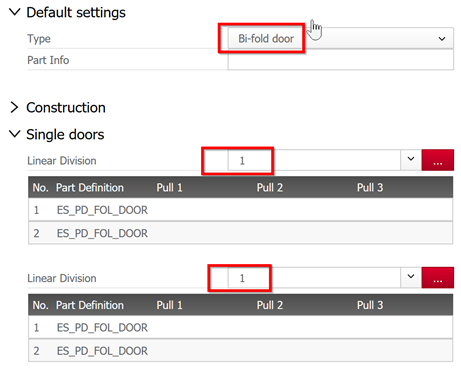
This characteristic is only evaluated for accessory parts of double folding doors. For a double folding door, a linear division is specified for left and right in the construction principle.
The connector is additionally inserted as an accessory connector only for double folding doors. As with all accessory connectors, the insertion point is the article insertion point. (Without drawing data. The accessory is only included in the parts list by being inserted).
Possible Values
Article number of any connector
Interaction with Other Characteristics
-
Notable
Only for double folding doors, i.e., folding doors that are hinged on both the left and right sides.
Entry for Part Type
Usable for part type 0.
General Characteristics
The general components are not specifically developed for the folding and sliding module but are universally used in imos. They can be used with all connectors and part types of a connector set.
Hide in Connector Scan (SHOW_DIALOG_FALSE)
If this characteristic is activated, the connector will no longer be displayed in the quick view of the Connection Scan. It is helpful for maintaining clarity in a fitting set. This characteristic has no impact on the parts list.
Start Point Bounding Box X / Y / Z (STARTPOINT_BOUNDING_BOX_X)
Defines the position of the start point of the bounding box for each axis starting from the origin point of the connector.
End Point Bounding Box X / Y / Z (ENDPOINT_BOUNDING_BOX_Y / _X / _Z)
Defines the position of the end point of the bounding box for each axis starting from the origin point of the connector.
Collision Grid (COLLISION_GRID)
For automatic correction attempts in case of a collision.
Only connectors assigned this characteristic will be corrected. The value of the characteristic can include an offset.
The connector is offset along the connection line (direction of linear division). The offset is checked multiple times, but a maximum of 100 times. The first suitable value is used.
A positive offset corresponds to a shift towards the midpoint of the connection line, i.e., inward. A negative offset corresponds to a shift away from the midpoint of the connection line, i.e., outward.
If the offset starts with +- or -+, both directions are checked. The nearest suitable position is used. In this case, a maximum of 200 checks are performed. If the nearest suitable positions are equally distant in both positive and negative directions, the positive direction is preferred for +- and the negative direction is preferred for -+.
Grid Dimension (COLLISION_OFFSETS)
For automatic correction attempts in case of collision.
Only connectors assigned this characteristic will be corrected. The value of the characteristic can include multiple offsets separated by a semicolon (;).
The connector is offset along the connection line (direction of linear division). The individual offsets are checked one after the other, and the first suitable value is applied.
A positive offset corresponds to a shift towards the midpoint of the connection line, i.e., inward. A negative offset corresponds to a shift away from the midpoint of the connection line, i.e., outward.
Constant 1 to Constant 4 (CONSTANT_1…CONSTANT_4)
Have no impact on the construction and can be used, for example, for calculations.