
Constructive connector characteristics - Rotating doors
Access
Ribbon : Main data > Main data > Element Manager > Connections > Connector
General Information
The constructive connector characteristics describe certain features of the connector. For example, you can modify the position of the connector in the article.
For rotating doors you can distinguish between the following types for the constructive connector characteristics.
Lock
| Preview | Characteristic-Name | Values | Explanation |
|
Locking system type (LS_TYP) |
The connector type is defined in the characteristic locking system type. | ||
|
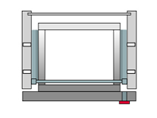
Lockcylinder, key plug, turning handle (LFRONT) | ||
|
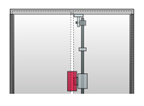
Lock plate, stop bracket (LPLATE) | ||
|
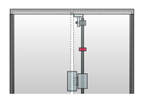
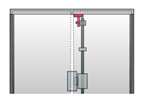
Rod guide (LRODHOLDER) | ||
|
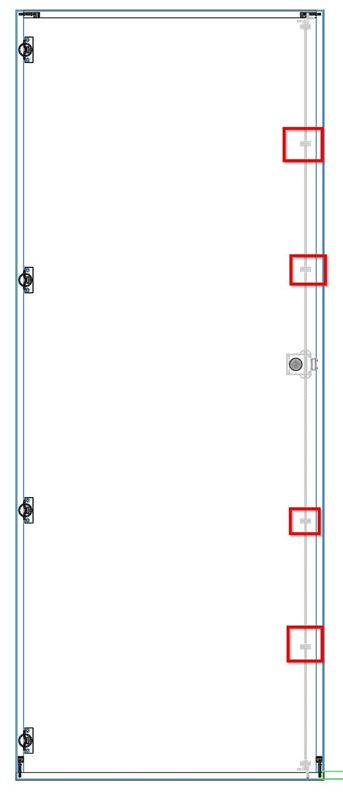
Order quantity of rod guides |
Order quantity only Real quantity times order quantity |
Controls the order quantity of guides/ mountings for espagnolette rods. The order quantity is considered in the table IDBPURCH.
Tip: The characteristic "Division rod" does not write the real amount (result of the linear division) into IDBPURCH. Use "Order quantity of rod guides" instead. |
|
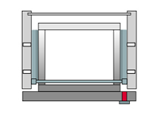
LPIN = Pin | ||
|
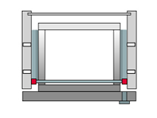
Lock (LOCK) | ||
|
LACT= Door latch LACT_L = Door latch left LACT_R = Door latch right |
||
|
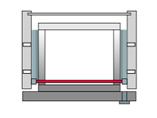
ROD = Espagnolette | ||
|
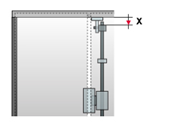
Locking latch reveal (LS_X) |
Number (editable) |
The characteristic indicates how far the lock latch will be revealed in the carcass. |
|
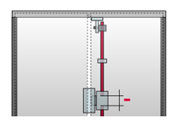
Espagnolette reduction middle (LS_LOCK_ROD_SUB) |
Number (editable) |
The characteristic indicates how the espagnolette should be shortened in the center (in the section of the lock). Can be left out with locks without rods. |
|
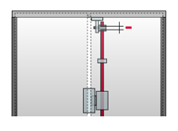
Espagnolette reduction Door latch (LS_LACT_ROD_SUB) |
Number (editable) |
Shortening the espagnolette on the lock latch. |
|
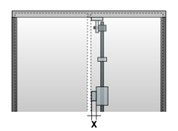
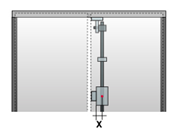
Bolt depth (LS_BOLD_DEP) |
Number (editable) |
he characteristic defines the bolt depth. |
|
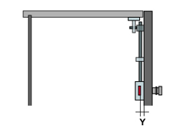
Backset (LS_BOLD_SIZE) |
Number (editable) |
The characteristic defines the so-called bolt depth. The bolt depth defines the distance between the insertion point of the lock and the edge. (Generally the insertion point is in the middle of the lock.) |
|
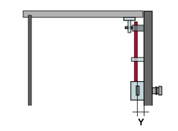
Distance bolt/door back (LS_BOLD_DIST) |
Number (editable) |
Door back panel distance to the bolt. |
|
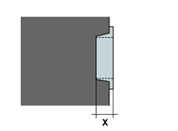
Offset espagnolette back (LS_ROD_DIST) |
Number (editable) |
The characteristic should be entered in lock. The characteristic should always be used. The characteristic indicates how far the espagnolette is shifted into the carcass. Can be left out with locks without espagnolettes. |
|
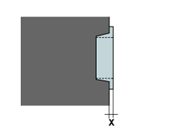
Depth lock plate (LS_PLATE_DEP) |
Number (editable) |
The characteristic defines the maximum depth how far the bolt can go into the lock plate. This characteristic is optional. |
|
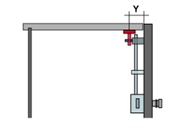
Overlap lock plate (LS_PLATE_SIZE) |
Number (editable) |
The characteristic indicates how far the lock plate protrudes from the carcass. |
|
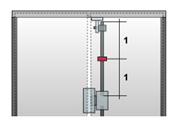
Distance door/pin (LS_PIN_DIST) |
Number (editable) |
Door back panel distance to the positioning pin center |
|
Division rod (LS_LINDIV) |
Linear Division Descriptor | The espagnolette is positioned with this characteristic. |
|
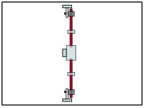
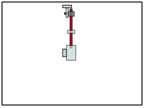
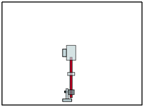
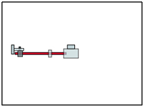
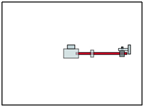
Espagnolette side (LS_ROD_SIDES) |
The characteristic is available for the lock pocket. Depending on the entered value the espagnolette goes through etc. | ||
|
0 = both sides | ||
|
1 = just top | ||
|
2 = just bottom | ||
|
3 = Only left | ||
|
4 = Only right | ||
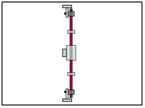
|
5 = through lock pocket | ||
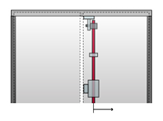
|
Offset off espagnolette to hinge side (LS_ROD_CENTER_DIST) |
Number (editable) |
The characteristic moves the espagnolette by the inserted value to the hinge side. Also moves espagnolette hook etc. |

|
Locksystem DWG (SECTION_DWG) |
File | DWG for cross-section geometry. The DWG can only have one polyline. The file-name can be entered with or without the file-extension *.dwg. The file must be in the directory <Library>\ConnDWG. |
Hinges
| Preview | Characteristic-Name | Values | Explanation |
|
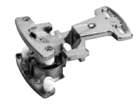
Twin hinge (ZWILL_SCH) |
J = Yes N= No |
Yes = It is a twin hinge. No = A twin hinge is not installed. |
|
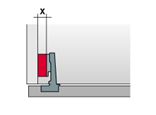
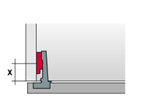
Example distance (DIST_X_EXAMPLE) |
Number( editable) |
Hinge connections define complex C-dimensions, distance and screw position. With the help of„ Example distance “ and „ Example screw position “ the values for a functional connector set are defined. imos automatically calculates further variants on the base of this connector set. The characteristic is only the output for angle hinges. |
|
Example screw position (LR_Y_EXAMPLE) |
Number( editable) |
Hinge connections define complex C-dimensions, distance and screw position. With the help of„ Example distance “ and „ Example screw position “ the values for a functional connector set are defined. imos automatically calculates further variants on the base of this connector set. The characteristic is only the output for angle hinges. |
|
|
Crank (Crank) |
Number (editable) |
The characteristic for the offset/cranking has to be set for calculating the lateral distance of the damper. If this characteristic is not available, the offset/cranking is evaluated with „ 0 “. |
|
|
Catalog type (CATALOGTYPE) |
Hinge | For the function elements end panel hinge and rotating doors. |
|
Reference point hinge (BEZUG_SCH) |
0= No effect | ||
|
|
1 = Offset of the machining to the door thickness | 1= Moves the group coordinates according to the part thickness of part 0. | |
|
|
2 = Front edge side/ offset of the machining to the side thickness | 2= Distance of the connector to the contour of the part 1, in z-direction of the connector, is added to the value of the characteristic GAP. | |
|
|
3 = Front edge side minus characteristic gap | 3= Moves the group coordinates according to the part thickness of part 1. Additionally the connector is inserted to the edge of part 1. | |
|
|
4 = front edge of the side | 4= Has the same influence as „Reference point to edge“. | |
|
|
Gap (FUGE) |
Number (editable) |
Has influence when BEZUG_SCH=2. Distance of the connector to the contour of part 1, in z-direction of the connector. Value is added to the value of BEZUG_SCH. |
Mounting plates
| Preview | Characteristic-Name | Values | Explanation |
|
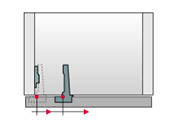
Distance mounting plate (DIST_X) |
Number (editable) | The characteristic defines the distance (Thickness) of the mounting plate. The workings of the hinge are shifted to the entered value. (In Y-direction connector coordinate system) |
|
|
Fix position of mounting plate (MES_OFFSET) |
1 = Yes 2= no |
1 = Under the condition that part 0 is onset, the machining and DWGs of part 1 will be moved to the part edge. If part 0 is inset, the characteristic has no effect. |
Buffers and Openers
| Preview | Characteristic-Name | Values | Explanation |
|
Buffer type (BUFFER_TYPE) |
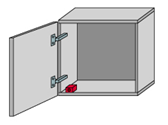
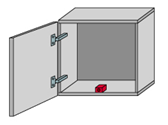
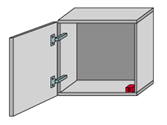
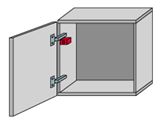
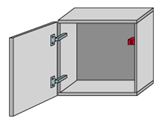
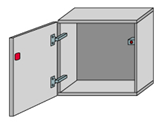
This characteristic defines that the connector is a buffer or rather an opener. The value defines where the connector is placed. |
||
|
1 | At shelf, at hinge side | |
|
2 | At shelf, at center of door | |
|
3 | At shelf, opposite hinges | |
|
4 | At side, at hinge side | |
|
5 | At side, opposite hinges | |
|
6 | Counter plate | |
|
Preferred position (BUFFER_PREFPOS) |
This characteristic is only appraised when there is only one buffer. | ||
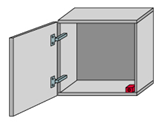
|
1 = Bottom | Value fits buffer at the bottom. | |
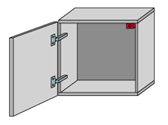
|
2 = Top | Value fits buffer at the top. (default). If this characteristic is not available, the buffer is inserted automatically at the top. | |
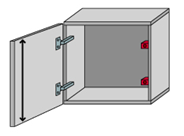
|
Front height for two buffers (BUFFER_Height42) |
Number (editable) |
The value defines from which door height (mm) a second buffer is necessary. If the value is „0“ there will be always a second buffer. If the characteristic is not used, the buffer is not inserted. |
|
Attach to hinges (BUFFER_ONHINGES) |
This characteristic is only appraised when the “Buffer type” is equal „At side, at hinge side”. | ||
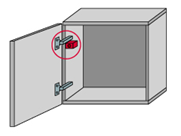
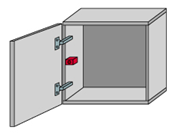
|
1 = Yes | The buffer is fastened to the first or rather to the last hinge. | |
|
0 = No | ||
|
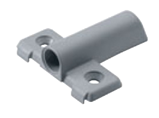
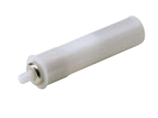
Is adapter (BUFFER_ISADAPTER) |
|||
|
1 = Yes | The connector is interpreted as an adapter. | |
|
0 = No | The connector isn't an adapter. | |
|
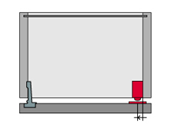
Counter plate distance (BUFFER_PLATEDIST) |
Number (editable) |
The characteristic defines the offset (mm) of the counter plate center. The insertion point is normally oriented to the carcass corner. This means that the offset is relative to the part thickness. If this characteristic is left, the value us evaluated with "0". |
|
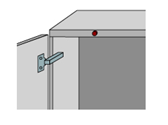
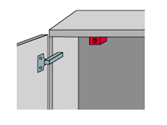
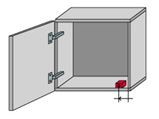
Edge position (BUFFER_CENTERED) |
|||
|
1 = Center | 1 = The insertion point of the buffer is oriented to the center of the shelf / side. | |
|
0 = Inside | 0 = The buffer is oriented to the inner side of the shelf / side panel. | |
|
Additional inset at inset fronts (BUFFER_INSET) |
Number (editable) |
The characteristic is used to define the distance of the connector to the carcase corner. The Value defines the distance (mm) of the connector to the carcase corner. This characteristic isn't relevant to the buffer type “At side, at hinge side”. |
|
Use single parts for Linear Division (BUFFER_ON_CHILDPARTS) |
This characteristic only has an effect of the front is a multi part. If this characteristic is activated the linear division is not applied to the mother part of the multiple part elements, but to all child parts that are located at the buffer side. It has no effect on single parts. The characteristic has only an effect if the buffer type is "At the side..." Maximum 2 buffers are inserted. |
||
|
Reference for Linear Division is only the front part (BUFFER_LINREF_IS_DOOR) |
If this characteristic is activated the linear division is only used for the front height. Top and bottom shelves are ignored. If it's not available the linear division is applied to the inner dimensions. The characteristic has only an effect if the buffer type is "At the side..." Maximum 2 buffers are inserted. |